Tokyo’s Summer Festivals & Fireworks: How to Celebrate Tanabata, Obon, Awa Odori & More
Tokyo’s summer season is full of life, and that’s because it doubles as festival season!
From firework displays (hanabi 花火) to festivals (matsuri 祭), many culturally rich events take place all over Tokyo between June and August that most travelers miss by sticking to fall or spring itineraries.

But as a slow traveler who’s spent two summers housesitting in Tokyo, I can confidently say that summer is one of the most underrated times to visit.
In the sultry evenings, people are outside dancing to Bon Odori festivals, enjoying riverside fireworks, and writing their wishes at shrines and temples. The city slows into something ancient and celebratory.
If you’re planning a stay in Tokyo, going in summer is extremely worthwhile (aside from the sometimes extreme heat).
In this post, discover more about Tokyo’s summer festivals, including Tanabata, Obon (and their Bon Odori dances), Hanabi, and more, including tips on where to stay and how to make the most of the festival season.
Tokyo’s Summer Festivals: Where & How to Join the Celebrations

Obon & Bon Odori Dances
- What: Circular folk dances commemorating the dead
- When: Late June through August
- Where: All over; local parks in Asakusa, Nakano, Sumida, etc
Dancing with the ancestors… that’s what Bon Odori festivals during Obon are all about! As one of Japan’s most loved summer traditions, experiencing (and participating in!) a Bon Odori festival is a must.
 The Bon Odori stage
 Joining in on the fun!
During Obon, it is believed that one’s ancestors come to visit. Rooted in Buddhist origin, it is an ancient Japanese tradition likened to the Mexican Day of the Dead.
The Bon Odori dance essentially consists of synchronized dancing accompanied by traditional songs and taiko drums.
You’ll find everyone of all ages joining in on these dances—and foreigners are welcome, too! I joined in on a Bon Odori festival near Sumida Park last summer and felt so welcome among locals. (Even though I didn’t follow the steps very well.) 😅
Most Bon Odori events are free and open to the public. Food stalls line the square, and a raised yagura (raised wooden platform) is at the center. The vibe is festive and community-led!
-> Search for places to stay near Asakusa and Sumida

Awa Odori
- What: Tokushima traditional dances, music (parade-like)
- When: Late July–August
- Where: Koenji (the biggest Awaodori), Kagurazaka, and other Tokyo wards
Another summer festival in Tokyo to experience is Awa Odori, which, unlike Bon Odori, is one of the liveliest and most expressive dance festivals.

Up to 12,000 coordinated dance performers can be seen at the Awa Odori Festivals, which date back 400 years to Tokushima. Today, the traditional festival is celebrated all across Japan.
Also, unlike Bon Odori, you don’t join in on these dances. Instead, the dance is known for its distinctive performances, music, and synchronized dancing, which you enjoy from the sidelines. There’s stomping, swaying, and twirling in rhythm to flutes, taiko drums, and chants.
Awa Odori feels more like a parade!
While Koenji hosts Tokyo’s largest Awa Odori every August, I attended a smaller version in Kagurazaka, which is considered Tokyo’s “Little Paris.”

It’s a historic hillside neighborhood with lots of charm.
The streets lit up with energy as dancers flowed past izakayas and rows and rows of onlookers. It felt like stepping into the past.
Hanabi (Fireworks)
- What: Fireworks festivals, celebrated with yukata and riverside picnics
- When: Late July (maybe early August)
- Where: Sumida River, Edogawa, other wards
The word for fireworks in Japanese, hanabi (花火), literally means “fire flower,” and watching them bloom and fade in the night sky over the Sumida River just feels magical. 🥹

Take notes on these hanabi events and dates!
Sumidagawa Fireworks Festival: Tokyo’s most iconic hanabi show is on the Asakusa/Sumida River in late July, but it is very crowded!
Edogawa Fireworks: Usually in early August; like Sumidagawa, but less popular!
Jingu Gaien Fireworks Festival: This hanabi show near Harajuku is the only fireworks show in Tokyo that is paired with live music performances. It’s pretty cool!
Tanabata Festival (Star Festival)
- What: A romantic summer tradition celebrated with lanterns and paper wishes!
- When: July 7th (or early August in some areas)
- Where: Zojoji Temple, Asakusa, other wards
One of my favorite Tokyo summer festivals is not really about dancing, but about star-crossed, celestial lovers.
Tanabata actually celebrates the legendary story of two celestial beings, who, supposedly separated by the Milky Way, are allowed to reunite just once a year—on July 7th!
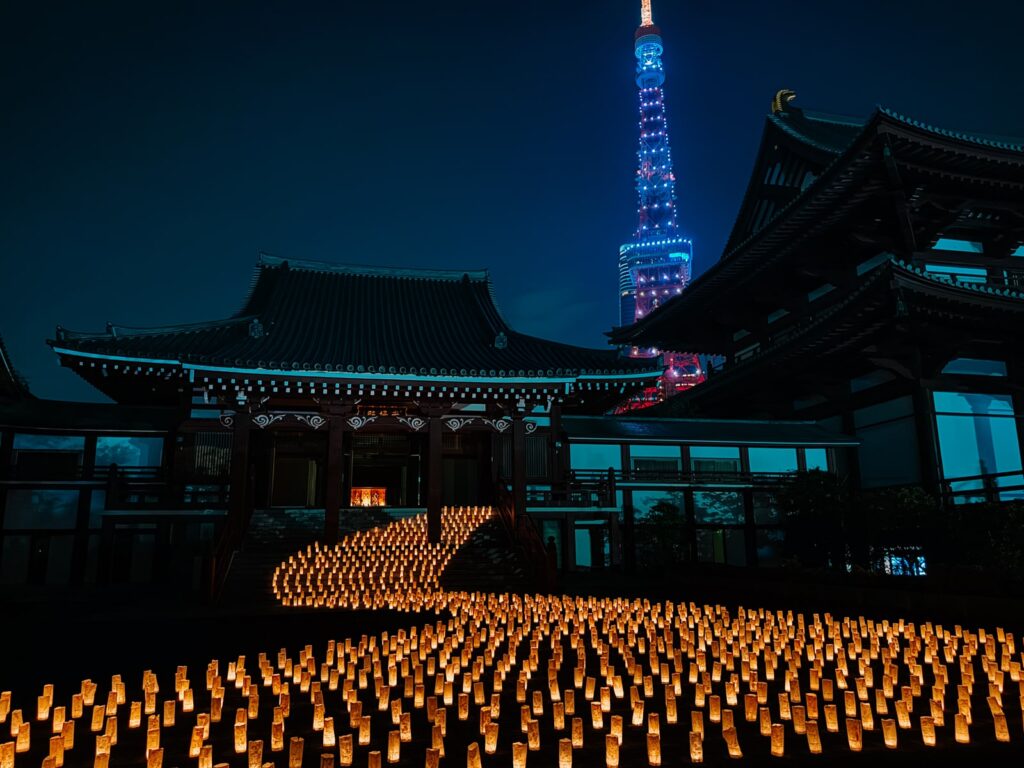
For this festival, we went to the Zojoji Temple and witnessed hundreds of handmade washi paper lanterns light up the temple steps.
You can purchase a colorful strip of paper known as a tanzaku (for 200 yen), write your wish on it, and tie it to the bamboo branches by the temple, and it will come true!
💫 Most people celebrating Tanabata pray/wish for love, health, passing exams, road safety, or simply finding happiness in this life.
Along with the others, Tanabata is a beautiful summer festival that is not to be missed in Tokyo!
Where to Stay for Tokyo’s Summer Festivals
Tokyo’s summer festivals bring in many more crowds, especially in the city’s busiest hubs.
Instead of going central, base somewhere with easy access to parks, temples, and riversides to enjoy more space.
Here are a few neighborhoods and stays I recommend for a slower experience.

Asakusa
Asakusa is one of my favorite areas of Tokyo, and I recommend staying here even for first-timers.
It’s home to the Senso-ji Temple, walkable to the Sumida River, and has plenty of local restaurants.
Stay in the Asakusa neighborhood for quick access to the Sumidagawa fireworks and Bon Odori dances.
You’ll need to book in advance, though, as Asakusa is becoming even more popular year-round!
Recommended stays:
- KoKono Club Asakusa – Boutique, artsy, near the temple
- The Gate Hotel Kaminarimon – Rooftop views, close to the river
- Wise Owls Hostel — Cheaper rates, view of SkyTree, and near Sumida Riverwalk
Ueno / Yanaka
Still in East Tokyo, Taito City, you’ll find Ueno and its smaller neighbor, Yanaka.
I love both of these areas for year-round stays, but they’re also amazing for enjoying Tokyo’s summer with easy access to Ueno Park.
While not as central a hub as Asakusa, you have plenty to do and see.
Recommended stays:
- Hanare Hotel — The village-like hotel where I stayed!
- Hotel Graphy Nezu – Community feel, great for slow travelers
- NOHGA Hotel Ueno – Designer hotel, breakfast is worth waking up for!

Koenji / Nakano
For late summer stays (August), check out Koenji (the little jazz/rock area of Tokyo) or Nakano (nicknamed Sunshine City).
I’d recommend staying here if you want to attend the Awa Odori Festival in mid-August. It’s also just a lesser-known area of Tokyo that remains super convenient for exploring the city.
More local, less touristy, but exploding with cute cafes, and West-side Tokyo charm.
Recommended stays:
- Illi Esu Nakano – Beautiful, spacious, apartment-style studio room in the heart of Nakano!

Minato / Kagurazaka / Ebisu
For a more south-central stay with convenient access to Shibuya, Ginza, etc. (without the crowds), stay in the Minato City area (Tokyo Tower), Kagurazaka, Ebisu, or in the neighborhoods around, but not in the heart of Shibuya.
All three are great in their own right, but they’re extra convenient hubs for experiencing Tokyo’s summer festivals.
Recommended stays:
- Trunk Hotel (Harajuku) — Tokyo’s coolest and socially-positive hotel in Harajuku.
- Hotel Gajoen Tokyo — This cultural and luxury “hotel museum” has a ryokan feel and 90 years of history (if you want to splurge!).
Most of all, pick an area of Tokyo that offers more than the main attractions beyond Shibuya, Shinjuku, Ginza, etc.
The quieter neighborhoods of the city have SO many overlooked gems, neighborhood cafes, galleries, and shops that are nice to explore in between festivals.

Final Tips for Experiencing Tokyo’s Summer Festivals
Between the crowds, the heat, and the events, summertime can be a bit of a sensory overload for some.
Arrive Early!
Try to go early to most festivals to make the most of your time.
Arriving early gives you time to purchase food and drinks, find a nice viewing spot (especially for festivals like Sumidagawa Fireworks), and enjoy the area before the crowds overwhelm you.
That said, staying late is also fun because you can catch the tail end of performances when most people have left to go home.
Stay Hydrated
Also, staying cool is cool! Remember to hydrate more often than normal and consider carrying cooling wipes or a towel.
Decide if You Wear a Yukata (Casual Kimono)
Part of the festival fun is wearing a Japanese yukata, which is basically a light summer kimono. You can rent one for the day or evening in Asakusa.
Last year, I wore my linen jumpsuit set and was glad I wore something breathable (and walkable, as we walked a lot!).
If you wear a yukata and geta sandals, bring a backup pair of shoes to change into after photos. You’ll want to, promise!
Most of all, enjoy this beautiful, spiritual festival season! If you can handle the heat, you’ll discover this is one of the best times to be in Tokyo.